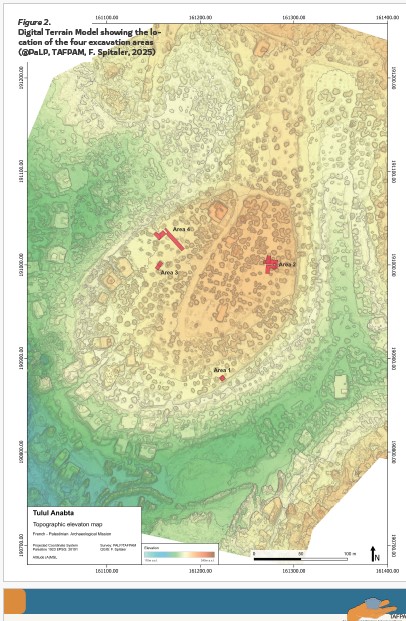
Since 2025, the Tulul Anabta French–Palestinian Archaeological Mission (TAFPAM) has been part of the archaeological cooperation program of the French Ministry for Europe and Foreign Affairs (MEAE). This multiannual project aims to investigate the earliest forms of urbanization in the Southern Levant through the exploration of the site of Tulul Anabta, located in the Tulkarem Governorate of Palestine. The mission is co-directed since 2025 by Blandine Besnard (Éveha International) and Ghassan Nagagreh, Assistant Professor at Dar al-Kalima University in Bethlehem. It brings together several institutional partners: the Palestinian Department of Antiquities, the French Institute of the Near East (Ifpo), the Archéorient Laboratory (UMR 5133, CNRS – Université Lumière Lyon 2), the company Éveha International, and the Bouguenais Jumelage Coopération.
The Site
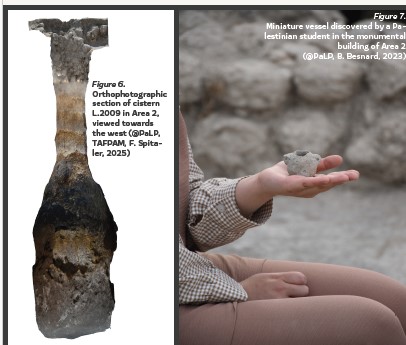
Covering an area of about five hectares, the site of Tulul Anabta constitutes a rare and exceptional example of a small fortified settlement of the Early Bronze Age (EB) II (ca. 3000–2800 BCE). Research undertaken since 2021 revealed a complex urban assemblage including a monumental defensive system, domestic structures, a monumental building possibly of cultic function, and several hydraulic installations. These well-preserved remains, largely free of later occupation, provide a privileged observatory for understanding the emergence of proto-urban societies in the region and reconstructing its cultural history.